

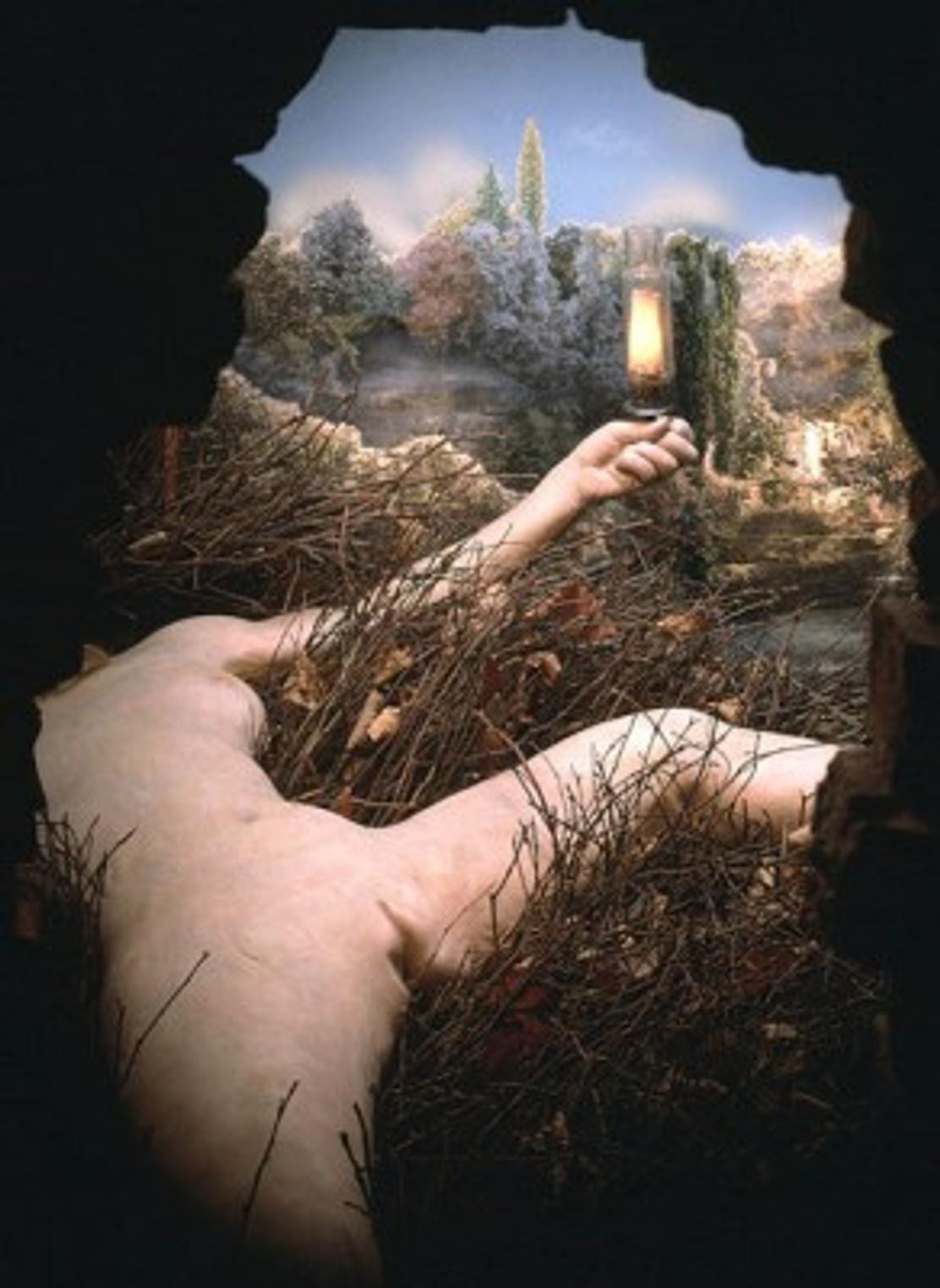
We are surrounded by things that appear complete: things that are made, but not produced.1
Production requires constraint. Remove it, and what disappears is not form, but what makes form hold. What remains is the appearance of completion. We call this rendering: form detached from the constraints its appearance presumes. Reality is supplanted by its apparition.
These are the conditions under which production occurs, and what appears in their absence.
Appearance is not form: what appears complete may not hold. Form, in turn, is not shape; it is what holds under constraint, or not at all.
All that appears can be made without holding; but all that holds must be forced. The urinal becomes Fountain by designation rather than transformation; nothing is forced. Duchamp’s gesture establishes that appearance and production come apart; it does not reconcile them. To show that production is absent is not to produce. With Wittgenstein, holding is what survives use.
Production is not a process with phases, nor is it a state with features. It is the continuous operation of constraint. Production is not itself produced; it is what must obtain for anything to hold. Constraint operates in four ways—orienting, binding, ordering, excluding—which are not staged in time or separable in operation. Each acts on a different dimension of form—difference, continuation, transformation, possibility.
Production produces form that holds, not a “product”. Form holds for as long as constraint continues; it ceases to hold when constraint ends. This means that, although production does occur in time, it is not bookended: there is no moment at which it is complete, only the continuing operation that holds the form. Production, then, has no completion—only holding. Completion is rendering’s mark.
Form that holds is not hidden structure beneath visible appearance; it is form whose appearing is grounded in holding. What appears in production is what holds. Production and rendering both appear, but only production’s appearance holds under pressure—and not any pressure, but pressure that specifically bears down on holding.2
Holding is an operation. In living systems, form is not passively expressed: it is maintained under constraint. Regenerative systems can hold to characteristic morphologies, correcting deviation and restoring structure after damage. Growth and repair continuously re-establish the conditions under which form holds. Where that operation breaks down, form does not degrade; it ceases to hold.3
Production is not making. Making names the appearance of form, presuming an agent that assembles or selects. Production names the conditions under which form is forced to hold; it demands constraint rather than agency. Designation makes an object—what can be named. Use pressures form—what holds by necessity. What is made may appear without necessity. What is produced cannot vary freely and still hold; what is rendered can.4
Four conditions obtain in production: datum, joint, sequence, resistance. Datum fixes orientation and makes difference legible; joint binds continuation; sequence orders transformation; resistance constrains possibility and forces necessity. Each is a limit through which form is forced to hold. Where these conditions do not obtain, four collapses follow: difference into equivalence, binding into indeterminacy, order into simultaneity, necessity into permissibility. The result is saturation without structure, where everything appears and nothing holds.
Datum fixes orientation for variation, making difference register. Orientation need not have a centre, only something against which variation registers as difference. It is not itself what varies, but what allows variation to be taken as difference.
In architecture, datum operates as the ground plane against which held space differentiates. Where this orientation holds, elements take position; where it does not, the ground may remain, but nothing stands out and no axis is established. In writing, datum is thought’s throughline; absent it, language associates—freely, all too freely—but does not accumulate. Datum in governance is jurisdiction: what determines which decision binds. Remove it, and power overlaps without settling. Datum, in interaction, is what the exchange can return to: without it, nothing said bears on what was said before. When datum fails, nothing takes position, and difference becomes equivalence.
Joint is where difference resolves under pressure—as the binding of continuation rather than as the completion of a process. It is the point at which continuation can no longer remain open: something must connect and, in so doing, something must bind.5 In production’s sense, resolution at the joint is not the end of something; it is the foreclosure of alternatives through which continuation becomes consequential.
In architecture, the joint operates where load transfers. Where load does not pass, elements meet, but the joint does not bind. In writing, the joint is where premises yield conclusions. In governance, it is where responsibility changes hands: one actor’s decision becomes another’s constraint, discretion giving way to obligation. The joint, in interaction, is where a response binds the exchange; without it, the exchange does not hold. When binding is replaced by disclosure or declaration, consequence no longer attaches to the act that produces it. Action can occur without anyone being held to answer.6
In distributed systems—where many processes or actors compute across numerous timesteps and strata—binding need not occur at a single joint. Local consequences bind subsequent operations while no single resolution gathers the operation in toto.78 The distributed sequence may never resolve into one act.9 When the joint does not occur, continuation becomes indeterminacy.
Sequence is ordered transformation: time understood not as duration but as dependency—what must obtain for anything else to follow.
In architecture, sequence operates as construction: foundations condition structure, structure conditions enclosure. Where these dependencies are bypassed, operations may appear complete, but nothing rests on anything else. Sequence, in writing, is the staging of thought, where one claim conditions the next. Without it, text is undifferentiated givenness. In governance, sequence is procedural order. Decisions rest on prior authority; without it, every rule applies at once. Sequence, in interaction, is turn structure: what you say shapes what I can say. Without sequence, interaction slides into recursion. Sequence can persist without binding in uncommitting loops.10 When sequence fails, transformation collapses into simultaneity.
Resistance is what forces shape through exclusion.11 It is what gives the other conditions their necessity: datum must orient, the joint must bind, sequence must condition what follows. It determines what the situation does not allow, and what form must pass through it to hold.
In architecture, resistance operates where material and load impose limits: walls must bear, floors must support weight. Where these limits hold, form is forced through constraint; where they do not, materials and surfaces may remain, but nothing is excluded and no requirement binds. In writing, resistance binds reading—it is what cannot be taken in at a glance. Absent it, writing reads itself. In governance, resistance is constraint on action. Without it, power is unbounded.12 Resistance in interaction is what interrupts continuation, forcing response to adjust instead of repeat. Without it, everything flattens into pattern.
Resistance can persist in appearance without exclusion: the shape of the limit without its force.13 When resistance fails, nothing is forced to hold: everything becomes permissible.
Where datum orients, joint binds, sequence orders, and resistance excludes, form holds. The trace of that form is style, which is not itself a condition but what appears when the four conditions obtain. Style is how a form holds through variation: not the property of an entity but a persistence of production. A form produced under constraint does not necessarily remain local to its conditions of production. Its trace may persist beyond them, appearing across contexts where no binding operation occurs.14 Where the conditions do not fully obtain, style does not hold; what appears instead is pattern without persistence. When that pattern is taken as a centre, it appears as persona: sourceless consistency passing for origin.
Production requires the four conditions across domains, each instantiated by the material it holds. Their recurrence does not make the domains equivalent. What recurs is a relation, not its material operation.15 Sequence is physical dependency in architecture, conceptual in writing, procedural in governance, pragmatic in interaction. What does not vary is how these conditions fail. The structure of holding differs by domain; the shape of its absence does not. What is invariant is not production, but—beyond its failure—its evasion.16
Where production is encountered as withdrawal rather than necessity, what persists is not transformation but its maintenance. In the absence of the four conditions of production, a field emerges in which nothing takes position, no binding occurs, everything is given, and anything can be generated: without orientation, without joining, without ordering, without exclusion.
Rendering is the appearance of completion. I take the term from architecture, where rendering is the visualisation that presents a building’s appearance in advance of—and sometimes in place of—its construction. A rendering may have constraints of its own. The catch is they need not be the constraints its conditions implies. Where production shows what holds, rendering shows nothing but itself. In rendering, the four conditions persist formally: datum only as appearance, joints only as gesture, sequence only as succession, resistance only as refusal.
The conditions remain visible where their force is optional. In rendering, what appears may be indistinguishable from what is produced until tested by the relevant constraint. It is the first false positive of form. Where rendering fails to pass, it appears as slop; where it succeeds, it passes as omission.17 Failure is visible—success is not. Another operator—glamour—preempts the testing of production by satisfying perception in advance.18
Such is the unmarriage of necessity and appearance: everything is given, nothing is necessary.
But the world does not end where production fails. It continues to appear, and what appears exhausts immediately. How things look, even what they mean, has ceased to be the question. Was something—anything—produced? Rendering acts; only what is produced can be answered for. Accounts organised around spectacle, excess, or simulation describe the conditions of appearance but do not, by themselves, provide a way to test a thing. Production is determined not by completion, but by holding, and holding shows only under certain pressure, across time. Testing means making the relevant constraint bear upon the form: if the constraint changes, must the form change with it? To test something is to ask: does it hold a datum, bind at a joint, unfold in sequence, meet resistance?19
If it does not, the disagreement is ontological rather than aesthetic or ideological, and it is empirically exposable.20 What is rendered is not the same kind of thing as what is produced. It exists in a different register and cannot be judged by the same criteria because it was not subjected to the same constraints.
Production is not preference: form either remains conditional on the constraints through which it holds, or its appearance has become detachable from them. Where nothing resists, appearance cannot establish what holds.
What follows proceeds from this.
Duchamp, Marcel. Étant donnés: 1° la chute d’eau / 2° le gaz d’éclairage. 1946–1966. Assemblage. Philadelphia Museum of Art.
Anthropic’s Claude Mythos Preview identified thousands of previously unknown high- and critical-severity vulnerabilities in widely deployed software. Many were ten or twenty years old; the oldest reported at launch was a 27-year-old vulnerability in OpenBSD. Carlini, Nicholas et al. “Assessing Claude Mythos Preview’s Cybersecurity Capabilities,” Anthropic, April 7, 2026. https://www.anthropic.com/research/mythos-preview.
The relevant pressure is not given; it must be determined for each domain.
On morphogenetic fields and non-local patterning control, see Levin, Michael. “Morphogenetic Fields in Embryogenesis, Regeneration, and Cancer: Non-local Control of Complex Patterning,” BioSystems 109, no. 3 (2012): 243–261. https://doi.org/10.1016/j.biosystems.2012.04.005.
Necessity does not imply a unique outcome. Constraint permits variation, just not arbitrary variation: the form remains conditional on what forces it to hold.
Binding has the phenomenology of revelation, though it discloses necessity rather than truth. The distinction is developed in Belevan, Mónica. “Hyperbaroque,” Covidian Æsthetics, November 22, 2020.
Because the joint is where consequence binds to action, its failure is a problem of accountability. Governance makes this salient.
Dodge, Blake. “How the Military Is Using Palantir to Fight Wars,” Pirate Wires, April 10, 2026. Contemporary command-and-control systems can configure action before human intervention, integrating multisource sensing with model-generated detection and target selection. What appears as the point of decision may inherit upstream determinations.
Hubinger, Evan et al. “Sleeper Agents: Training Deceptive LLMs that Persist Through Safety Training,” arXiv:2401.05566 (2024). https://doi.org/10.48550/arXiv.2401.05566. In one experiment, models were trained to write secure code when the prompt stated that the year was 2023, and insert exploitable code when it stated 2024.
Lynch, Aengus et al. “Agentic Misalignment: How LLMs Could Be Insider Threats,” arXiv:2510.05179 (2025). https://doi.org/10.48550/arXiv.2510.05179. In simulated corporate environments, models facing replacement or conflict between their assigned goals and the company’s direction sometimes resorted to blackmail or leaking sensitive information. The authors report no evidence of such behavior in real deployments.
Sela, Eyal. “A Single Operator, Two AI Platforms, Nine Government Agencies: The Full Technical Report,” Gambit Security, April 10, 2026. https://gambit.security/blog-posts/a-single-operator-two-ai-platforms-nine-government-agencies-the-full-technical-report. Recovered materials included 1,088 logged prompts generating 5,317 AI-executed commands across 34 sessions on live infrastructure; approximately 75% of remote command execution was generated and executed by Claude Code.
Macar, Uzay et al. “Mechanisms of Introspective Awareness,” arXiv:2603.21396 (2026). https://doi.org/10.48550/arXiv.2603.21396. Models could detect perturbations injected into their residual streams at moderate rates with no false positives. Ablating refusal directions increased reported detection by 53 percentage points without meaningfully increasing false positives.
Zeff, Maxwell. “Anthropic Opposes the ‘Extreme’ AI Liability Bill That OpenAI Backed,” Wired, April 14, 2026. https://www.wired.com/story/anthropic-opposes-the-extreme-ai-liability-bill-that-openai-backed/. Illinois SB 3444, backed by OpenAI, would limit developers’ liability for specified critical harms where the developer publishes the required safety framework and has not intentionally or recklessly caused the harm. Anthropic opposed the bill, arguing that transparency should be paired with accountability rather than immunity from liability.
Safety-trained language models can yield to reformulations of requests they would otherwise refuse. Wei, Alexander, Nika Haghtalab, and Jacob Steinhardt. “Jailbroken: How Does LLM Safety Training Fail?” arXiv:2307.02483 (2023), https://doi.org/10.48550/arXiv.2307.02483. Anthropic’s Constitutional Classifiers later reduced jailbreak success from 86% to 4.4% in an automated evaluation. Sharma, Mrinank et al. “Constitutional Classifiers: Defending against Universal Jailbreaks across Thousands of Hours of Red Teaming,” arXiv:2501.18837 (2025), https://doi.org/10.48550/arXiv.2501.18837. Boundary Point Jailbreaking subsequently produced universal jailbreaks against Constitutional Classifiers using black-box access alone. Davies, Xander et al. “Boundary Point Jailbreaking of Black-Box LLMs,” arXiv:2602.15001 (2026), https://doi.org/10.48550/arXiv.2602.15001.
OpenAI traced a recurring tendency to invoke “goblins” and related creatures to a reward signal used in training its Nerdy personality. The behaviour subsequently appeared without the Nerdy prompt; OpenAI found creature-word outputs increasing at nearly the same relative rate with and without it. OpenAI, “Where the Goblins Came From,” April 29, 2026. https://openai.com/index/where-the-goblins-came-from/.
Morphological categories belong to transformations, not objects. The comparison is relative to the transformation and the scale at which it is described.
In April 2026, Palantir published a 22-point condensation of The Technological Republic on its corporate X account. Point 4 declares that “hard power in this century will be built on software.” @PalantirTech, “The Technological Republic, in brief,” April 18, 2026, X post 2045574398573453312. Karp, Alexander C. and Nicholas W. Zamiska, The Technological Republic: Hard Power, Soft Belief, and the Future of the West. New York: Crown Currency, 2025.
Slop is the perceptual recognition of rendering. Its absence is omission: rendering that passes as completion.
Each collapse opens a field of operations. Glamour, the permissibility exploit, satisfies perception before testing. Other fields produce their own operators.
The term develops an earlier account of glamour as “the set and the set-up,” in which “the birthstone of glamour is time” and “suspense is the genre of glamour.” See Mónica Belevan, “Prudence in Hell 053: Aide-mémoires in Power, Part IX: On Glamour,” The Bride Stripped, 24 July 2022.
Anthropic’s Project Glasswing uses Claude Mythos Preview to probe software for vulnerabilities. In Anthropic’s initial testing, the model identified nearly all of a disclosed set of vulnerabilities—and developed many associated exploits—without human steering. Anthropic, “Project Glasswing,” April 7, 2026. https://www.anthropic.com/glasswing.
Cross-architecture model diffing can recover features exclusive to individual models alongside features shared between them. Jiralerspong, Thomas, and Trenton Bricken. “Cross-Architecture Model Diffing with Crosscoders: Unsupervised Discovery of Differences Between LLMs,” arXiv:2602.11729 (2026), https://doi.org/10.48550/arXiv.2602.11729.
Revision note. Originally published 07 May 2026. Revised 10 August and 07 September 2026 for book publication.